Wednesday, February 10, 2016

Madagascar: In Search of Omura's Whales

Dr. Salvatore Cerchio is a marine mammal biologist who has studied free ranging populations of cetaceans around the world for more than 30 years. He is currently a Visiting Scientist at the New England Aquarium, with a guest affiliation at the Woods Hole Oceanographic Institution. In November 2015, he went off the grid to study Omura's whales off the coast of Madagascar. 

The Omura’s whale (Balaenoptera omurai) is a recently-discovered species of baleen whale, first recognized as a distinct and ancient species in 2003. Previously confused with Bryde’s whale (B. edeni), at the time of its discovery it was known only from a handful a strandings and specimens from whaling, and never documented in the wild. Then in 2013, my team and I made an exciting discovery off the northwest coast of Madagascar: the first population of this rare and poorly understood species that could actually be studied, found off the northwest island of Nosy Be.


I have been conducting research on cetaceans in Madagascar since 2004, and studying coastal dolphins and cetacean diversity in the Nosy Be region since 2007. The work on Omura's whales began in 2013, when we started to see an unusual baleen whale during an effort to document diversity of cetacean species in the region. At first, with only a few brief encounters, we thought it was a Bryde’s whale, a common mistake. But then once we started to see them more frequently, we realized that this was something very special, and genetic verification confirmed that it was in fact Omura’s whale.

Since then we have published the first scientific study on the ecology and behavior of the species in Royal Society Open Science. In 2015, I joined the New England Aquarium as a Visiting Scientist, and currently the work continues through an international collaboration between the New England Aquarium, the Malagasy NGO Les Baleines Ass'eau, and the Madagascar Centre National de Recherches Océanographiques (CNRO). During 2015/2016, the work is funded by the U.S. Marine Mammal Commission, and focuses on studying feeding ecology, acoustic behavior, status and distribution of the population around Nosy Be.

In the coming blog posts, I will document some of the exciting happenings and discoveries of the November 2015 field season. Stay tuned!

— Sal Cerchio

Sunday, January 24, 2016

MCAF: Sawfish research in the Eastern Tropical Pacific

This post is one of a series on projects supported by the Aquarium’s Marine Conservation Action Fund (MCAF). Through MCAF, the Aquarium supports researchers, conservationists and grassroots organizations all around the world as they work to address the most challenging problems facing the ocean.

In the blog post below, MCAF grantee, Ruth Leeney, PhD, founder and director of Protect Africa’s Sawfishes describes working with the Peruvian NGO, Planeta Oceano on groundbreaking studies of sawfish in Peru and Ecuador; a collaboration that was facilitated by MCAF.

One sawfish species — the largetooth Sawfish (Pristis pristis) — is thought to have occurred
historically in the eastern Pacific, along the coasts of northern Peru, Ecuador, Colombia, and the
Pacific coast of Central America. Until recently, there was little research focusing on sawfishes in
Central or South America, but a number of projects have recently developed which promise to change all that.

A largetooth sawfish (c. 5.6 m total length) captured off northern Peru in February 2015.
(c) Alejandra Mendoza/ ecOceanica

The Marine Conservation Action Fund has been a strong supporter of projects focusing on rays. Until
recently, rays attracted less attention and research than sharks, despite being just as endangered, if
not more so. For example, the sawfish family, which consists of five species globally, is the most
endangered of all shark and ray families (sawfishes may look like sharks but they’re actually
classified as rays!). The MCAF supported my research on sawfishes in Mozambique in 2014 and a
number of projects on manta and mobulid rays, including research activities by Peruvian NGO
Planeta Océano. So when Planeta Océano was developing a new project to investigate whether
sawfish were still present in Peru, MCAF’s Elizabeth Stephenson connected them with Protect
Africa’s Sawfishes, and a new collaborative project was born.

Ruth Leeney discusses sawfish with the owner of the fishing boat that
caught and released a largetooth sawfish in northern Peru, February 2015.  © Angel Escobar


In February 2015, Planeta Océano ran a training course on sharks and rays. As part of the course, I
provided both an introduction to sawfish identification, ecology and conservation, and training on
how to use interview surveys to collect baseline data on rare species. The training course was
attended by participants not only from Peru but also from Ecuador and Colombia, including
undergraduate students, fisheries officers, and even a professor from Tumbes University, where the course was held.

After a day of intensive training, Planeta Océano staff and the course participants visited fishing
ports and landings sites in northern Peru. Very recent captures of largetooth sawfish have occurred
in northern Peru, including one 5.6-metre long adult caught and released alive in February 2015 (see photo above), so we were eager to learn more about that capture and why the fishermen had been motivated to release the sawfish. I was delighted to meet the fisherman who owned the boat from which that catch had been made, and whose sons were amongst the crew that day. He explained that one of the crew members knew that sawfish are rare and had contacted a local NGO for advice on what action to take. The crew brought the sawfish back to the port, got assistance from local fisheries officers with untangling it from their net, and released it. This is a wonderful example of the positive impact that numerous Peruvian NGOs are having on the attitudes of small-scale fishers towards marine conservation issues.

A fun feedback session with the course participants.
© R. Schwoerer

After our first day of interviews, I gave the students feedback on the information they had collected
during interviews. I was genuinely impressed with the high standard of data collection and the
enthusiasm of everyone involved. We conducted two more mornings of interviews at other sites
along the coast, and even got to visit the Reserva Nacional Manglares de Tumbes, – a beautiful area
of mangrove forest and creeks, winding out towards the coast and the border with Ecuador.

Dr. Rigoberto Rosas-Luis from Ecuador, interviewing fish vendors in northern Peru.
© Ruth H. Leeney

The interviews with the men and women involved in fisheries along Peru’s north coast revealed
some fascinating information, which suggests that sawfishes were more common in the waters of
northern Peru than previously thought. Planeta Océano has also built collaborative links with teams
in Ecuador, El Salvador, and Costa Rica, supporting them to collect data on sawfishes using similar
methods, and developing community awareness activities and educational materials on sawfishes,
to be used throughout the region. Planeta Océano's collaborators at the Universidad Laica Eloy
Alfaro de Manabí (Ecuador), many of whom attended the training course in Tumbes, conducted 429
interviews with fishermen throughout Ecuador in 2015, and documented a recent capture of a
sawfish (in 2014) in San Lorenzo, northern Ecuador.
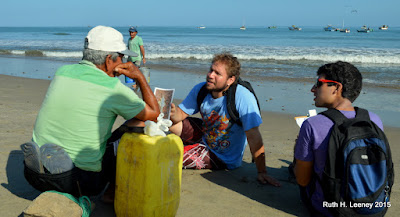
A fisherman being interviewed by course participants Cristhian and Andre at Zorritos beach.
© Ruth H. Leeney

I was heartened to meet so many students with curiosity, insightful questions, and an energetic
approach to research. This project was a wonderful example of the work MCAF facilitates, not only
by supporting projects financially but also by creating a network of marine conservationists and
researchers, bringing together people with similar goals. Continued collaboration amongst NGOs,
researchers and other teams in Central and South America will allow for a faster, more comprehensive assessment of the conservation status of sawfishes in this region and the actions we
need to take to protect them.
"The visits to landings sites and ports in the Tumbes area (northern Peru) were great. …..the course has provided me with new skills and the knowledge to create new research projects in Ecuadorian waters." 
– Jonathan Pincay, student at Universidad Laica Eloy Alfaro de Manabí, Ecuador
Ruth Leeney and Kerstin Forsberg with some of the course participants
and a local fisherman, at Zorritos beach, northern Peru. © Ruth H. Leeney

Ruth Leeney was supported by the Swiss Shark Foundation. Planeta Océano's sawfish research is funded by the Mohammed Bin Zayed Species Conservation Fund. Many thanks to Elizabeth Stephenson of the New England Aquarium's Marine Conservation Action Fund, for linking Planeta Océano with Protect Africa's Sawfishes and encouraging collaboration to advance sawfish research and conservation!

— Ruth Leeney

Monday, January 4, 2016

The Secret Sawfishes of the Philippines

This post is one of a series on projects supported by the Aquarium’s Marine Conservation Action Fund (MCAF). Through MCAF, the Aquarium supports researchers, conservationists and grassroots organizations all around the world as they work to address the most challenging problems facing the ocean.

In the blog below, MCAF grantee, Ruth Leeney, PhD, founder and director of  Protect Africa’s Sawfishes gives us a preview of her upcoming expedition (partially supported by MCAF) to find undocumented populations of sawfish in the Philippines. 

Fishers in Honda Bay, Palawan. Interviews with fishermen will play a key role in Ruth Leeney’s effort to determine the presence of sawfish in the Philippines. Photo: Ruth Leeney.


Information on sawfishes in the western Central Pacific Ocean is scarce, but the rivers, mangroves and tropical coastal waters around the Philippines’ 7,107 islands probably once provided some ideal hiding places for undocumented populations of largetooth, green and narrow sawfishes. Laguna de Bay, a large lake close to the Philippines’ capital city of Manila, was once a prime habitat for sawfishes. In 1870, the German naturalist A.B. Meyer spent a month on the eastern shore of the lake and reported that several large sawfish--up to a length of 7 m (20 ft)--were brought to the Santa Cruz market each day!

This largetooth sawfish rostrum was found during surveys of southern Mindanao, the Philippines, in 2015. Finding out where and when this rostrum was harvested can help determine where sawfish might still be found in the Philippines. Photo: © Shannon Arnold
But are sawfishes still present here or, as is the case in so many other parts of the world, have these secret sawfish populations disappeared? It’s time to stop wondering, and to go in search of answers!
In 2016, Protect Africa’s Sawfishes will work with The Large Marine Vertebrates Research Institute Philippines (LaMaVe), a local NGO; the Zoological Society of London (ZSL) and the Filipino Bureau of Fisheries and Aquatic Resources (BFAR). LaMaVe have a number of teams throughout the various island groups of the Philippines.

We plan to train these teams and send them out to communities throughout each region, to interview fishermen and fish vendors about sawfishes: asking whether they still catch them, where they encountered them in the past, and when they last encountered a sawfish. We will also search in markets for the characteristic saws or ‘rostra.’ Along the way, the teams will explain why we are collecting this information on sawfishes and about the threats faced by sawfishes globally. We hope to interest Filipino communities to take a greater role in protecting these unique creatures.

LaMaVe has already succeeded in raising awareness about whale shark and manta ray conservation and management throughout the Philippines, and has engaged with both communities and the Filipino government on these issues. We hope that this project will uncover new information about sawfishes in the Central Pacific Ocean and will bring sawfishes to the forefront of marine conservation efforts in the Philippines.

Wednesday, December 2, 2015

Devil Ray Island: Tagging the Elusive Rays

This post is one of a series on projects supported by the Aquarium’s Marine Conservation Action Fund (MCAF). Through MCAF, the Aquarium supports researchers, conservationists and grassroots organizations all around the world as they work to address the most challenging problems facing the ocean.

In the blog and video below, MCAF grantee, Ramón Bonfil, PhD, founder and director of Océanos Vivientes, A.C. (Living Oceans) describes his recent expedition to tag devil rays in the Archipelago of St. Peter and St. Paul, 600 miles off the coast of Brazil.


by Ramón Bonfil

The 56-hour boat trip is grueling, with rough seas, a freezing cabin and an incredibly uncomfortable bed, but we finally get to the tiny rocks creeping out of the sea in the middle of the Atlantic Ocean, the Archipelago of St. Peter and St. Paul (ASPSP). Perhaps it’s surprising for a marine biologist, but I often get sea-sick and I just do not enjoy boats for more than a few hours, however the beauty of this little marine paradise is totally worth the hardship of the trip to get here!
The Archipelago of St. Peter and St. Paul (ASPSP) offers spartan quarters for researchers.
The Archipelago of St. Peter and St. Paul (ASPSP) offers spartan quarters for researchers. 
We will see many charming and graceful animals while we are here, but our main aim is to unveil the movements and migrations of the devil rays that frequent these islands. Devil rays and their close relatives, the manta rays, have come increasingly under threat since a deceitful and lucrative business developed in Asian markets about a decade ago.

Traders claim that the gill rakers of manta and devil rays have miraculous curative powers for all sorts of ailments and market them as traditional Chinese medicine. The reality is that there is absolutely no evidence of this being a traditional product in Chinese medicine, nor is there any scientific evidence that gill rakers cure any ailment.

The need to help turn the tide and protect devil and manta rays drives us to learn more about their life cycles, habitat needs and the threats they face. By inserting electronic tags that link to environmental satellites, we can follow the movements of the devil rays around the ocean and get detailed records of where they go, how deep — and how often — they dive, and what water temperatures they prefer and tolerate. We may find that they stick to small areas (such as the ASPSP), which can be more easily protected. Or they may migrate widely across the Atlantic Ocean, crossing into the waters of several countries and facing many threats, which would make them much more difficult to protect.

A Speck in the Ocean

I am here with Sibele Mendonça and Bruno Macena, graduate students and collaborators in the devil ray ecology project led by my friend and colleague Dr. Fabio Hazin, from the Department of Fisheries and Aquaculture of the Universidade Federal Rural de Pernambuco (UFRPE) in Recife, Brazil.
satellite tag tethered in shallow waters in front of research station. Crabs visible.
Prior to deployment the satellite tags, like the one shown here, must be prepared and tested for readiness. The tests take most of the day as the scientists must wait for the satellites to pass overhead several times before they properly locate the transmitting tags.
We spend our first two days unloading and preparing all our equipment and food and settling down in our modest but charming research station. The ASPSP is almost 1,000 km from the coast of Brazil, so we must bring with us absolutely everything we will need here during our 2-week stay. We are only four people here, like a Robinson Family stranded alone on this beautiful, but extremely inhospitable, rocky outcrop from the mid-Atlantic Ridge.

During our stay, we will get to see the cute ‘atobás’ (brown booby birds, Sula leucogaster) with their romantic displays and fluffy nestlings, the beautiful ‘viuvinhas’ (brown and black noddies, Anous stolidus and A. minutus), dolphins and lots of silky, dusky Galapagos and hammerhead sharks (and if lucky a whale shark or two), in addition to the main attraction of our expedition…the Chilean devil ray (Mobula tarapacana) and its sibling, the bentfin devil ray (M. thurstoni).

brown boobies perched on dock leading to research station
A brown booby, Sula leucogaster, finds a perch at the research station.

Into the Water

With our gear stowed and our tags calibrated, at last I set out on my first day on the water. This year, I’m hoping to improve on last year’s performance and place at least three tags with even more detailed data capabilities. I haven’t yet had time to prepare the tagging pole, so all I hope to accomplish on this first day is to find the devil rays, photograph/film them, and, most importantly, take tiny samples of muscle, so that we can do a genetic analyses of each individual.

aerial view (from drone) of five or more rays, with diver
An aerial drone helps the scientists locate groups of devil rays. 
Within 20 min of looking into the sea from the top deck of the boat, I see the first olive-brownish shape of a large Chilean devil ray about 15 m from the starboard side of the boat. I rush down to the main deck to put on my fins and mask and get my camera and sampling pole, but by the time I am ready, they have disappeared. I jump into the water anyway and the fishermen on the boat soon spot another group of devil rays about 50 m from the boat. Soon, I have my first tissue sample, taken from a beautiful 2.2 m-wide Chilean devil ray!

3 researchers seated on the boat's transom, smiling
The research team relaxes between tagging efforts. From left to right: Ramón Bonfil, PhD, Oceános Vivientes A.C. and Sibele Mendonça and Bruno Macena, graduate students in the department of fisheries and aquaculture of the Universidade Federal Rural de Pernambuco (UFRPE), in Recife, Brazil 
As I first approached the group and dove deep, the lead devil ray turned around and all of them avoided me; looks like they do not like the approach from below. I keep swimming in the direction they disappeared, and in a blink they are back. Now I realize there are five or six of them in the group. This time I dive shallower and start an intercept approach at their depth. The closest devil ray lets me approach slowly and calmly from behind until I am about to touch her back. I am so close I even have to slow down to allow enough distance to shoot my Hawaiian sling and take the sample of muscle. We use a small metallic tube that cuts a tiny cylinder (5 mm diameter) of muscle. It is like a body piercing to us. The devil ray reacts to the pinch by dashing off, but she is back to check me out within 15 seconds!

Curiosity Tagged the Devil Ray

The next couple of days we do not get to see the devil rays. But eventually our luck comes back with a group of 4 devil rays next to the boat. When Sibele and I jump into the water, the devil rays circle back to check us out once they detect our presence.

Chilean devil rays are very curious. More often than not, they come back to give us a look and see what we are up to, often gently ‘flying’ directly towards us, and — just when we think we will get to touch them — diving or turning to avoid us and keep their distance. Most times, they hang around us for three to five minutes, and sometimes come back for another couple of passes even after we tag them or pinch them for a little tissue sample. This is in stark contrast with the other devil ray inhabiting the ASPSP, the smoothtail devil ray M. thurstoni. Smoothtail devil rays are elusive and it is rare to see them while snorkeling.

diver, with spear sling, descending from above devil ray through turquoise waters
Bonfil prepares to tag a devil ray.
As soon as the group circles back towards me, I dive in; the rays dive deeper, and I cautiously follow behind trying not to scare them. The first two rays of the group outswim me, but the third one comes within range. I press myself to the limit of my breath and close into the ray in front of me as she slows down. I decide this is my chance, aim carefully and gently let my Hawaiian sling go. The dart with the tag goes in smoothly and lodges in a perfect spot towards the rear left side of the beautiful 2.2 m female Chilean devil ray! We have tagged “Anita,” our first devil ray of the expedition, with a miniPAT tag. We are elated! After so much effort and wait, grant application writing, buying equipment, making preparations and traveling all the way here, we have started to achieve our fieldwork objectives within the first few days of work!

Our luck just gets better day after day, and in the next few days we obtain biopsy samples from more individuals and we manage to deploy two further miniPAT tags on the same day! One on a ca. 2.5 m male (Arturo) and the other on a ca. 2.3 m female (Genie, in honor of the late Genie Clark).

two rays, dappled with sunlight, swimming through turquoise water
The team named this tagged devil ray “Arturo.” 
All in all, the expedition turns out to be a complete success. With the help of a drone we got with our MCAF grant, we were able to locate even more devil rays than usual, and obtain tissue samples from eight Chilean devil rays. In addition, we shot some fantastic footage and photos of the Archipelago, our work and the devil rays, including what may turn out to be unique footage of courtship behavior of the elusive bentfin devil ray.

As we pack our gear to return to civilization, there is a bittersweet feeling of getting back to the comfort and ‘normality’ of life in a city, and the realization that we have to leave behind this fantastic place and the rewarding work we do here.


Following on a faculty fellowship visit to Dr. Fabio Hazin’s research group in Brazil, Bonfil and Hazin have formed a partnership to better understanding the biology and ecology of devil rays — as well as the threats they face — to design better conservation measures for them. The project is funded by MCAF and several other sources, including Save Our Seas Foundation, the Brazilian Research Council, the Interministerial Secretariat on Marine Resources, Universidade Federal Rural de Pernambuco and Oceános Vivientes A.C.


Additional information on manta ray conservation:


Wednesday, November 4, 2015

Protecting a Unique Population of Blue Whales

This post is one of a series on projects supported by the Aquarium’s Marine Conservation Action Fund (MCAF). Through MCAF, the Aquarium supports researchers, conservationists and grassroots organizations all around the world as they work to address the most challenging problems facing the ocean.

Dr. Asha de Vos will be visiting the Aquarium November 7-13 as the first of nine Ocean Conservation Fellows, under a program funded by the Institute of Museum and Library Services to connect field conservation work from around the world with the Aquarium's local programs and audiences. She will deliver a free public lecture, "Saving the Unorthodox Whales of Sri Lanka," on November 12, 2015.


Asha de Vos head shot
MCAF grantee Asha de Vos, Ph.D., is a TED Senior Fellow
and a World Economic Forum Young Global leader.
Photo: Yasha Hetzel
The waters of the North Indian Ocean —particularly off the southern coast of Sri Lanka —are so productive that an unusual population of blue whales chooses to feed, breed and calve in these warm tropical waters year-round.

The trouble, says Sri Lankan marine biologist and MCAF grantee Asha de Vos, PhD, is that the southern coast of Sri Lanka is also home to one of the busiest shipping lanes in the world. Several North Indian Ocean (NIO) blue whales have died in documented collisions with ships in recent years. These reports are likely “just a fraction of the individuals who get hit and killed in this manner, given that most carcasses either sink or get pushed offshore,” says de Vos.

Photo-identification methods help de Vos recognize individual
blue whales and estimate the size of the NIO population.
Photo: Steve deNeef
According to her research, these “unorthodox whales,” as Dr. de Vos calls them, are quite different from blue whales in other ocean basins.
The NIO whales “speak a different dialect, are about 20 feet shorter than their Antarctic counterparts (who can grow to about 100 feet) and display different behaviors than other populations,” says de Vos.

Her research suggests that the whales may not need to migrate long distances because oceanographic processes keep their home waters productive throughout the year. “The key thing is that Sri Lanka is situated in the heart of the Northern Indian Ocean, which experiences a monsoonal climate,” says de Vos. During the two monsoons, two different processes bring cold, nutrient-rich water toward the surface. The result is a year-round buffet for the whales.

Dr. De os (far left) and her research team survey the Northern
Indian Ocean for marine life. Photo: Steve De Neef
In general, upwelling regions are important sources of marine productivity and are known to attract many species from up and down the food web. “In Sri Lanka, the availability of food and warm  tropical waters makes it sound like the most idyllic place to live,” says de Vos.

Beyond studying the behavior of this unique population, de Vos is currently working to reduce the risk of whale death by ship strike. With partial support from MCAF, de Vos is assessing risk to this population over a broad area and is testing the results of a computer model to predict where blue whale habitats might overlap with shipping lanes in areas that aren’t accessible to survey vessels. With this information in hand, it may be possible to adjust shipping lanes to reduce the threat of ship strikes.

More information on Asha de Vos:
Free Aquarium Lecture: November 12, 2015
TED Talk: Why You Should Care About Whale Poo
New York Times Video: Saving Blue Whales