Showing posts with label South Africa. Show all posts

Saturday, January 14, 2012

Penguins on the Rocks

Now that I have been home for a bit, I've had a chance to reflect on my amazing experience in South Africa. It's still bittersweet at this point: I'm happy to be home but would LOVE the chance to go back to Cape Town and the penguins I miss so much!

Pair hanging out (photo by Jake Levenson)
I've settled back into my regular routine which has allowed me to plug through my 1,300 picture! Some of my favorites are of the penguins that can be seen at Boulders Beach, one of two mainland colonies of African penguins. Boulders is unique in that visitors to the colony can get up close to these birds, both along a boardwalk that has people visiting restricted-access nesting areas as well as part of the beach where penguins and humans can intermingle freely! Yup, you could walk right up to a penguin and snap some pictures!


Good advice before walking onto the beach!


Sun for people, shade for penguins
Always educating! (photo by Jake Levenson)

I was able to see lots of penguins, both on the beach itself as well as in the upland area where they rest and have their nests. It was so surreal to see these birds among the trees tucked in between roots and shrubs!
 
How many penguins can you find?

   
Penguins live in trees?
   
Back on the beach, penguins were everywhere! You would find them resting near boulders, on top of boulders, swimming in the water, everywhere! It was hard to remember that these animals are endangered with so many of them around. They didn't seem to mind when you got closer to take some pictures, but they didn't hesitate to give you a stare down when you did get to close for comfort!

Someone is pretty excited...
 While walking through the group, I did see some penguins with metal bracelets. It's possible that these birds had seen some time at SANCCOB, which will band chicks after rehabilitation and before they are released. It helps scientists track the birds after release to see how they are doing. If this bird was a SANCCOB bird, it seems to be doing well, even finding a mate!

A pair of penguins, one banded

Being able to come back to Boulders and observe the penguins helped me feel like the trip came full circle. Having previously released SANCCOB birds at this location and seeing how the wild birds were able to take full advantage of this site gave me a bit of hope for the species. I don't know what the future holds for the African penguin and the Boulders colony, but I do know I am thankful for doing my part to help this species and for SANCCOB and others that work hard to do so as well. I hope that many generations can visit Boulders to see these amazing animals and am glad that I got to witness it first hand! [Another Aquarium educator visited Boulders Beach in 2010 as well.]

On top of the boulders at Boulders (photo by Jake Levenson)


-Jo

Learn more about the Southern African Foundation for the Conservation of Coastal Birds, or SANCCOB and their Penguin Chick Bolstering Project.

Follow the adventures of Jo's co-worker, Paul! Aquarium penguin biologist Paul Leonard was also in South Africa to study and care for African penguins in the Southern Hemisphere! Read about his experiences on the Penguin Blog

Thursday, November 10, 2011

Packing for South Africa

Anyone who has traveled knows that there are equal parts excitement and nerves bouncing around your brain. And on the eve of my travels to South Africa, that’s exactly where I‘m feeling. Nerves and excitement!


My name is Jo and I’m an educator in the Visitor Experience team at the Aquarium. I teach our visitors all about the ocean world, the animals that live there and how we can help make it a better place. It’s a tall order to be sure! But fortunately I have some great animals and exhibits to talk about which makes it a lot easier. And what exhibit do I find myself talking a lot about? Our penguins!

Teaching visitors about turtles

People seem to bond with them easily, falling head over tails for their waddles, vocalizations and fantastic wardrobe choices. But many people don’t know how tough it can be to be a penguin. That’s where I come in. I can share the story of our penguin colony and use them to talk to visitors about penguins in the wild and the challenges they face. And that is the reason I find myself packing for the trip of an educator’s lifetime.

Aquarium's Penguin Exhibit (Sarah Estrada)

Thanks to a professional development grant given by the Aquarium, I am headed to South Africa to learn more about the African penguin, the struggles they face and what people are doing to help. I‘ll be volunteering at the Southern African Foundation for the Conservation of Coastal Birds (SANCCOB) where I will see and experience first hand how this organization works to rehabilitate oiled, injured, sick and orphaned birds. I will also be able to talk to other educators in South Africa, learning how they educate and spread the word about these amazing birds. In the end, all of this information will come back with me to Boston and be used to further our educational messages about these animals.

Penguins on the beach (WikiCommons)


So here it is. The eve of my trip and the nerves are still there. But after thinking about what I’ll be doing, the balance is starting to tip more and more into the excited column. I hope that you’ll read along for the next few weeks and see how amazing penguins can be. In the meantime, I have to continue packing!

Jo

Learn more about the Southern African Foundation for the Conservation of Coastal Birds, or SANCCOB and their Chick Bolstering Project.

Follow the adventures of Jo's co-worker, Paul! Aquarium penguin biologist Paul Leonard is also in South Africa to study and care for African penguins in the Southern Hemisphere! Read about his experience on the Penguin Blog.

Thursday, February 4, 2010

Last Question: What if we blended in?

Sunnye Dreyfus, South Africa Expedition

Cederberg, World Heritage Site

Blazing sun, broken arm, raging allergies, brightly colored clothing, a bad attitude and inappropriate footwear. I was so not prepared for the Cederberg and the cape leopards she was hiding.

I was dreaming of the ocean surrounded by at least 20 species of shark and schools of juvenile pufferfish. Thankfully, there is no law that regulates the scientific feasibility of dream content. Instead, I was being jostled around cape leopard habitat. No, not leopard seal or leopard shark habitat, but the 4-legged, furry land kind.

Rather than kelp forests, I was shepherded through bone-jarring rocks experienced via foot or 4-wheel drive. I had to hold my arm in the air every time we hit a huge bump in the road (which was all the time for 2 hours). I was sneezing in sets of 7 as the dust & pollen of the Cederberg found a cozy nook in my nasal passages.

The formation to the left of my head is called the "tea kettle" by some.
I think it looks like a turtle.

I was in a car full of strangers and absolutely no idea what I was doing or where I was going. Just looking out the window made me thirsty and I was a fish out of water in my city slicker duds. Self-loathing crept up on me as I thought of all the ocean I was missing because of this stupid cast on my arm. What do cape leopards have to do with anything right now?

Honestly, Sunnye. Really? How very uneducator-like of you.

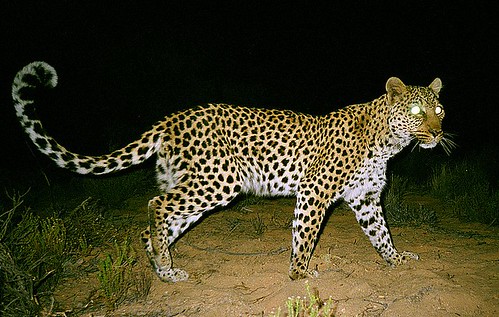
A beautiful day in the Cederberg...says the leopard.

Looking for cape leopards is really quite fantastic because it gives you a lot of time to reflect and meditate. I was sitting (awkwardly) on a rock (there were many) wondering (as always) how I got there. I was struck by the quiet peacefulness and unwavering patience of those around me. There were six of us with binoculars, telemetry and GPS gear, cameras, camping chairs, coolers, two vehicles, water, backpacks, food, hushed whispers and a ration of hope.
All of this...for a girl.

I never saw her, but I know she saw me. She saw all of us. How could she not?

There she is...do you see her? I didn't think so...
Like so many animals, she is a master of a natural subtlety we call camouflage: the art of blending in. I am sure she was quietly licking her paws, flicking her tail like some spastic metronome, or navigating the rocks like quicksilver. Whatever and wherever, we were not privy.

Photo credit: capestorm, flickr

And humans? Well, we stick out like sore thumbs. We yap, trap, laugh, graph, huff, puff, develop, envelop, dig, rig, mine, whine, drive, dive, fly, cry, screech, bleach, travel, unravel. If it's out there, we do it...and often loudly, quickly and on an enormous scale. And the rest of the animal world goes on and does their best to stay out of our way.

Cape leopards, like sharks, are still mysteries to us and so it is understandably unnerving to hear about our interactions with them. Some farmers, like some fishermen, hunt, exterminate, trap, and/or dispose of these apex predators and send a message in the process:
Stop eating my sheep.
Stop getting caught in my nets.
And most of all, stop threatening me.

So, what if we just blended in?
How would this world be different?
Do you ever try to blend in? How do you do it?
After being a sore thumb for so long, how do we blend in with all of the other digits?
And are we interested in doing so?

We are the shortest finger after all.

Dear South Africa, Thanks for having me. Sincerely, Sunnye

To learn more about cape leopards, check out the Cape Leopard Trust.
To see all of Sunnye's posts from South Africa, click here.

Thursday, January 21, 2010

Question #3: What's it like having two oceans?

Sunnye Dreyfus, South Africa Expedition

Last week I visited the Two Oceans Aquarium. It is centrally located on the waterfront, with a sweet little cafe and gift shop, sand tiger (ragged-tooth) sharks, African penguins, and fantastic staff, just like us!


Because of the location of Cape Town (the southern tip of Africa), the 2OA's collection hails from both the Atlantic and Indian Oceans. According to Head of Education, Russell Stevens, there is little need to look any further than their own "backyard" for their exhibits. They have just a handful of species that don't call the Indian or Atlantic Oceans home. Some of the highlights of my visit included:

  • Plankton exhibit: the lifeblood of the ocean should have spotlight, right?
  • Soles and puffer fish exhibits: it was great fun trying to find them hiding in the sand.
  • Shy sharks: endemic to the south and west coast of South Africa; mostly cold water species. I believe there are 5 species ... abundant and beautiful. They are called shy sharks because they use their tail to cover their eyes and snout when they feel threatened. Shark yoga, if you will. Puff adder shy sharks, leopard shy sharks, pajama shy sharks. Great names, huh? They come complete with fantastic specimens, big screen monitor, and an enthusiastic interpreter.

  • Kelp Forest: they play soothing music and some people swear that the fish and kelp choreograph accordingly. I found myself wanting to curl up at the holdfasts and take a nap.

  • Upper, middle and lower river region exhibit: I loved how the exhibit started high and ended low. Clanwilliam yellowfish, sawfin, sandfish—the level of endemism (species found in a specific area) decreases as you get to the lower regions because they are more susceptible to invasive species of bass, trout, and catfish as well as runoff from agriculture.

  • Fynbos exhibit: Plants native to the Western cape of South Africa! Pronounced "fane-bohs" meaning "fine bush" in Afrikaans, there are about NINE THOUSAND species and 6,200 of them are endemic to the Cape. They account for the highest density of plant species in the world (over 1,300 species per 10,000 square km)! Fynbos are packed like the Green Line on game day in just 6 percent of the country, but they account for over half of all plant species in South Africa and 20 percent of all species found on the entire continent! Yeah! How cool is that? I love (sniff, sniff), love (cough, cough) love (ah-choooo!!!) fynbos. I have never experienced so many plants, colors, flowers, fruits, seeds, and sinus congestion!
  • Wild cape fur seals (30 of them!): lounging on the docks just outside the cafe.


  • Learning labs: they have two and I voiced my loving envy. The first classroom (formerly a computer lab) had enough lab tables and chairs for 60 students and enough permanent tabletop tidepools to allow 1 per every 2 students! The second classroom had a border of marine animal tanks to choose from depending on the program.
  • Rethink the Shark: this was a corridor next to the predator exhibit in which they had large photos of sharks, information and statistics, and the Rethink the Shark video looping on a large screen.
  • Last, but not least is the hagfish exhibit. I love hagfish and it is about time these beauties have their own spotlight.
Conservation considerations
Something that really stood out to me after visiting the 2OA was their inclusion of Homo sapiens into their exhibits. There were three creative and simple ways I observed this being done.

Lining the base of the predator tank are species ID placards and I just happened to notice that one of them was for the human. It read: "Human, Homo sapien, A fierce predator found in both warm and cold waters. Preys on sharks, finning them alive and leaving them to drown in open seas. Offspring, if uneducated, may imitate behavior of adult species."


There was a sign posted from the INSIDE of the predator tank that read: "Warning: Predators beyond this point."


As I was leaving the main exhibits, there were giant images of a shark and a lion and in between was a giant mirror with text reading: "Planet Earth's most dangerous predator." It made me think and shook up my perspective a bit. And I'm sure that is what we who work at zoos and aquariums want to encourage our guests to do, right? Because perspective-shaking thought leads to learning, learning leads to knowledge, knowledge gives way to awareness and awareness has great potential to evolve into action. All of this can happen from a simple mirror installation. I love education.


Wildlife List:
Cape wagtail (Motacilla capensis)
Red-winged starling (Onychoganthus morio)
Rock pigeon (Columba guinea)
Sugar bird (long tails, very cool flight pattern)
Heron (hanging out with the thousands of penguins at Betty's Bay)
Hyrax, "dassie" (their closest relative is the elephant)
Blue crane with chicks! (national bird of South Africa)
Grey-winged francolin
White stork
Grey mongoose
African millipede
Sunbird
Bomslang (venomous back-fanged arboreal snake that likes bird eggs)
Baboon spider (thankfully, it did not know how to open car doors)
Weaver birds
Goats, duck, geese, rabbits, Bantams and Rhode Island reds (chickens)
African grey parrot named Rastus, and a Jack Russell named Bob

-Sunnye

Monday, January 11, 2010

Question #2: Why don't we think through things?

Sunnye Dreyfus, South Africa Expedition

This is a tale of shark bites, baboon encounters, broken bones and garden penguins.


African penguins, Boulders Beach (Photo: Sunnye Dreyfus)
Allow me to touch on the subject of shark nets. I have had the chance to chat with Chief photographer for Save Our Seas Foundation and marine biologist, Thomas Peschak. In his most recent Africa Geographic article (May 2009) he questions the relevancy of shark nets. Fifty years ago, there were five folks along the KwaZulu-Natal Coast in South Africa who had unfortunate encounters with sharks resulting in either injury or death. The remedy: installing 45 km of gill nets along the coast to avoid future encounters between sharks and humans. This "equal opportunity" method has resulted in the deaths of not only tens of thousands of sharks, but also of turtles, rays, dolphins, whales, and countless other non-target species. Over the course of my lifetime (give or ... give a few years), over 33,000 sharks have been caught, with hammerheads and dusky sharks receiving the biggest blow (accounting for nearly 50% of that number and ironically 0% of the initial shark bites). That is in addition to the tens of millions that are killed every year by fishing fleets throughout the world.

Conservation considerations
Why don't we think through things? I will be the first to admit that knee-jerk and (in many cases) pressure and fear-fueled reactions seem natural and appropriate in the beginning. How many times have you said to yourself, "it seemed like the right decision at the time"? These decisions can range from deciding whether or not to go back into the house to grab your reusable grocery bags, print double-sided, buy organic or, in this case, whether or not to install shark nets as the best tactic to reduce harm to humans. Isn't this the essence of sustainability? The key to living sustainably, or "living blue" as we say here at the Aquarium, is to question the intention. Is your intention to do your part in reducing waste or to get your to-do list checked off before sundown? Is your intention to protect humans, reduce shark populations, keep the mom and pop beachside businesses afloat, or subconsciously instill a fear of sharks? All of the above? Some of the above? It's tough to think, moreover act sustainably, no? I love to cook. And as a lover of food, I would like to submit my recipe for sustainability.

2 cups questions
1 cup thought (the fresher, the better)
1 cup intention
1/2 cup consideration
1/2 cup balance
1/4 cup butter, softened (because Julia Child said so)
2 tablespoon (heaping) moderation
1 tablespoon accountability (same amount of Activism may be substituted)
1/4 teaspoon backpedaling
Pinch of guilt (careful not to over season)
Add effort to taste

Slowly sift in intention. Mix thoroughly and let sit overnight. Fold in consideration, balance and moderation. Mix in accountability, backpedaling, guilt and butter until stiff peaks form. Bake in solar oven until browned. What is your recipe? Would you care to share? [Comment below!]

Cape Point, South Africa (Photo: Sunnye Dreyfus)

I almost forgot the bit about the broken bones. So, there I was hiking in the ostentatious African sunshine at Cape Point. My friend thought it would be a great idea to go check out some of the tidepools. South African tidepools? A rainbow of anemones, mussels and urchins? Sweet little endemic fish that trail your heels like puppies? OK, twist my arm ... No, really.

Baboons (Photo: Sunnye Dreyfus)

I was warned, not once but twice about the slippery seaweed-coated rocks and the waves that would love nothing more than to sweep me off my feet and make a mermaid out of me. Did I listen? Not so much. The waves didn't get me, but the rocks pulled me down with such gravitational longing that the moment I landed, I smiled acceptingly and calmly and yelled across the rocks to my friend, "I'm pretty sure I just broke my wrist." So, after a brief encounter with a male baboon that nonchalantly opened my car door, and after spending some beholding the wonder of the Cape of Good Hope, I took my wrist to the hospital. The X-rays confirmed that my little distal radius, like a favorite piece of pottery, was broken and in need of repair. Thankfully, it did not have to be reset; it wasn't my right hand, or my leg. I have to remind myself of this every time I think of feeling sorry for myself when I can't go diving or even peel an orange without assistance. I haven't had a cast on my arm since preschool. Why don't I think through things sometimes?


African penguins, Boulders Beach (Photo: Sunnye Dreyfus)

I might not be able to do everything I set out to do on this trip, but I refuse to see it as a set back. I just might need to flex my creative muscle a bit more. The rough plan right now is to do an 8-day exploration around the Western Cape. And now, for the wildlife...


Parasitic wasp who just paralyzed and laid her eggs in this rain spider. Once the eggs hatch, they will feast on the spider. (Photo: Sunnye Dreyfus)


skink (4"), not sure what species... (Photo: Sunnye Dreyfus)

Wildlife list:
1. Skink
2. Parasitic wasp
3. African penguin!!! (Boulder's Beach, urban population. I find it hilarious that the residents find it a nuisance when the penguins wander into their gardens. Do they have any idea of the street value of penguin guano? A gardener's dream!)
4. Ostrich
5. Chacma baboon (note to self: they can open car doors)
6. Cape cormorant
7. White-breasted cormorant
8. Kelp gull
9. Cushion stars
10. Cape anemones (denim blue, cotton candy pink, creamsicle orange)
11. Cape sea urchins
12. Bontebock (antelope endemic to the fynbos region of South Africa)
13. Southern rock agama
14. Angulated tortoise
15. Klipvis (the little endemic tidepool fish that liked my toes)
16. Rock sucker
17. Mussels
18. Limpets

-Sunnye

Tuesday, January 5, 2010

South Africa: How did I get here?

Sunnye Dreyfus, South Africa Expedition

Do you ever have those moments in life when the record scratches, you look into the camera and exclaim, "How did I get here?" I have had several of those moments in life ... teaching physics through a game of tug-of-war with 8th graders in the Marshall Islands ... the afternoon I had tea with the local town "witch" in the hills of Sligoville, Jamaica ... being drenched in fish poo after successfully unclogging a 750-gallon tilapia tank in the Bahamas ... attending a wedding reception in the back of a bowling alley in Wisconsin. If my soft little brain could have comprehended it, I'm sure I would have asked this question on the day I was born.

Two days ago, I was running along the edge of the world in the sleepy little town of Pringle Bay in South Africa and I heard that record scratching in my head again.

Kooel Bay, on the drive to Cape Hangklip

After a 14-hour flight from Houston to Dubai (8,179 miles) followed by a 9-hour flight from Dubai to Cape Town (4,732 miles) and a staggering 21 tons of CO2 later, I am here on the other side of the world for the next 3 weeks with several questions to explore in the realm of marine conservation education. I hope to learn more about institutions and individuals seeking to bring ocean conservation to the forefront of everyone's minds. Ultimately, this information gathering will help feed into the redevelopment of our sharks outreach program and some of the work we do around climate change education.

I've gathered a few questions from staff here at the New England Aquarium, which includes the following:
1. How do institutions teach about conservation? Climate change?
2. What kind of research is happening at these institutions and how do they play a role in their local communities (general public as well as business)?
3. What are the current issues surrounding the interface between fisheries and penguins & sharks?
4. How do education programs encourage stewardship?

If you have any more questions, please comment and I will do my best to explore it!

Wildlife list:
1. African black oyster catcher, Haematopus moquini
2. Pied crow, Corvus albus
3. Hadeda Ibis, Bostrychia hagedash
4. Hartlaub's gull, Laurus hartlaubii
5. Feral pigeon, Columba livia
6. Speckled mouse bird, Colius striatus
7. African rain spider, family Sparassidae
8. Cape fur seal, Arctocephalus pusillus
9. Helmeted guineafowl, Numida meleagris
10. Tern, Nohus ideaus
11. Gecko, Notso shurus
12. No baboons yet, but they have been known to tease the local dogs in Pringle Bay. They get the dogs to chase them down the road. They stop, turn around, slap the unsuspecting canines on the snout and then take off running again.

Hadeda Ibis, Pringle Bay
Dankie and stay tuned!

-Sunnye
(Note to self: need to plant 450 trees when I get back home.)