Showing posts with label hermit crab. Show all posts

Wednesday, August 14, 2013

Rally For A Claws!

As I've been posting about for years, hermit crabs are NOT hermits! They are actually quite social. They often get together in small groups (2-20) for shell exchanges, food congregations, and other gatherings. However, all of those social interactions are minor when compared to this: a genuine hermit crab mass migration!

Each year throughout the Caribbean, there’s a migration that matches the vast wildebeest migrations across the Serengeti. In the dark of night, thousands of terrestrial hermit crabs (Coenobita clypeatus) set out from inland forests, scrambling along jungle paths and tumbling down mountainsides until they reach the shore. There, thousands of hermit crabs congregate on just a few beaches, forming giant hermit crab conventions. Previously known only from local folklore and scattered scientific reports, in 2012 this phenomenon attracted widespread media attention after it was filmed on St. John USVI by Steve Simonsen (see below).


Such hermit crab conventions are clearly an impressive natural phenomenon, yet their root cause remains mysterious, as does their timing. We are planning to study these migrations, but in order to do that, we first must locate them. And to do that, we need YOU! Hence: rally for a claws. Ba-dum-dum. :-)

Do you know anyone on St. John? Are you going there on vacation? Or elsewhere in the Caribbean? If so, you can help participate in our research project by helping us to find the crabs!

Simply record your observations and submit to this website. 

In return, we'll keep you posted on this blog. More information can be found in this news story from the St. Johns Source Newspaper.

Thanks, and happy crabbing!! :-) 

Hermit crab migration - Coenobita clypeatus - photography by Steve Simonsen

Friday, July 5, 2013

Belize 2013 | Riders of the Storm

New England Aquarium coral biologist Randi Rotjan, PhD, and aquarists Peter Gawne and Joe Masi have recently traveled to Belize to monitor coral health near Carrie Bow Cay. Tune in here for updates about their research and animal encounters, and see pictures from previous expeditions herehere and here

Today's post comes from Peter Gawne.

Conditions here at Carrie Bow have worsened. A tropical depression has formed off the coast of Belize. We’ve been pretty well socked in by the weather with winds sustained over 35 mph, and 11 inches of rain in the last 48 hours. Sea conditions have become very rough as well, with waves from 5 to 7 feet, which has kept us from being able to safely access the reef.

The heavy winds of Tropical Storm Barry begin to batter Carrie Bow Cay.

Even the hermit crabs seemed to know that it is going to be a bit of a rough ride. As the storm intensifies the crabs have headed for high ground. Midway through the afternoon many of the hermit crabs have climbed the palm trees, and are looking down on us from their coconut perches. It is amazing that the crabs can hang on while gale-force winds buffet the trees!

Water rises beneath the outbuildings, while waves build and crash over the reef.

For the humans on the island, it is a similarly rough ride. Our lodgings, while typically weather-tight, have met their match with this wind and rain. Many of us had a long sleepless night, trying in vain to stay warm and dry. It was an odd experience—sort of like trying to sleep as someone sprinkles you with a garden hose, accompanied by a high-pitched moaning of the wind through the rafters. It is not an experience I would care to duplicate.

Wednesday, July 3, 2013

Belize 2013 | Close Encounters

New England Aquarium coral biologist Randi Rotjan, PhD, and aquarists Peter Gawne and Joe Masi have recently traveled to Belize to monitor coral health near Carrie Bow Cay. Tune in here for updates about their research and animal encounters, and see pictures from previous expeditions herehere and here

Today's post comes from Peter Gawne.

It has been an interesting week picking up where Randi and Joe left off.  Jay, Manda, and I have started wrapping up field transects, lionfish lab work and helping with filming wherever possible. [A BBC film crew was on the island to study hermit crab vacancy chains. Here's a guest post from the personal blog of cinematographer John Brown.]

Hermit crabs on Carrie Bow Cay | Photo: John Brown via

A goliath grouper holds in a deep overhang.

The transects in the field are going very well, although strong winds and rain are threatening to keep us shore-bound. When we are able to get underwater, we are seeing some fish that we rarely see on transects. Goliath groupers, midnight parrotfish and yellow-cheek wrasses have been some of the highlights.

A hawksbill turtles eyes the camera.

We’ve been seeing some rather large turtles with some frequency while diving. It should come as no surprise that turtles are in the area, as it is the time of year for turtles to haul up on the beach and lay their eggs. Amidst the recent stormy weather we were visited by a nesting turtle in the middle of the night. She came ashore, leaving tracks to show where she had excavated a nest in the sand. Belize Fisheries will come over to the island to assess the condition of the nest, if weather allows.

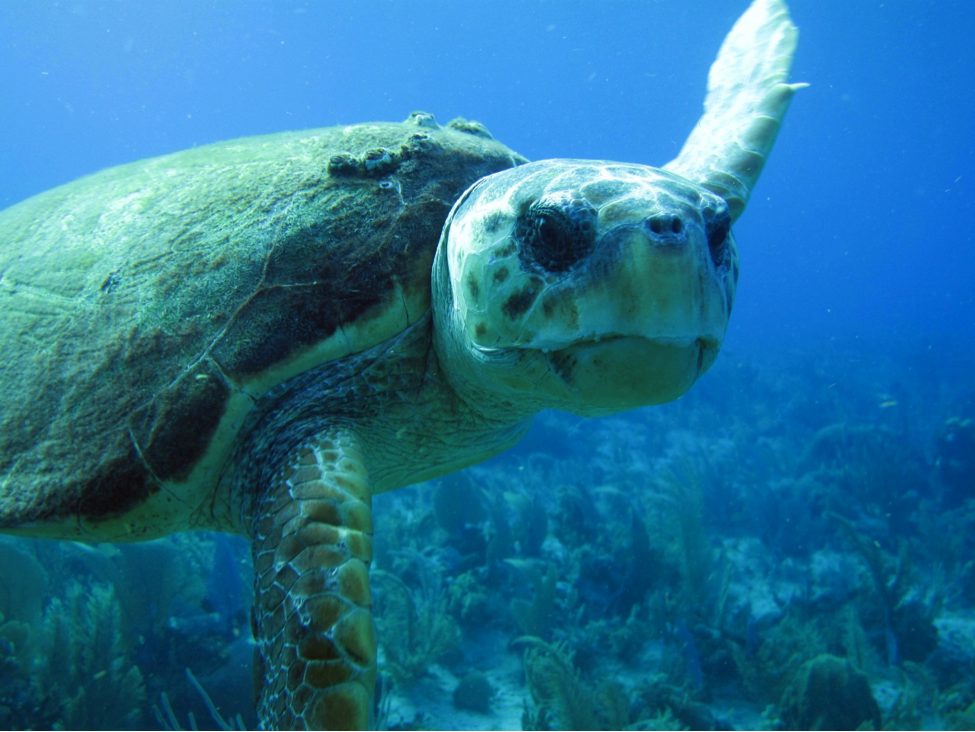
This large loggerhead turtle seemed especially interested in our party of divers.

When we encounter sea turtles underwater, they are often shy and reluctant to allow a close approach.  The turtles around Carrie Bow seem to be unusually curious during this trip, often approaching within arm’s reach. We have been really fortunate to have had some really close encounters with some rather large loggerhead and hawksbill sea turtles.

Wednesday, June 26, 2013

Belize 2013 | Guest Post From BBC Cinematographer

New England Aquarium coral biologist Randi Rotjan, PhD, and aquarist Joe Masi are in Belize monitoring coral health near Carrie Bow Cay. Tune in here for live updates about their research and animal encounters, and see pictures from previous expeditions herehere and here

Today's entry is a cross-post from the personal blog of BBC cinematographer John Brown. 

A fantastic couple of weeks in a genuine tropical paradise. The crabs did everything that we were told that they would and more. It’s a really incredible behaviour and possibly unique to hermit crabs and humans. We certainly couldn’t think of another species which forms these ‘synchronous vacancy chains’ – individuals queue in order to move up from a limiting resource to a more suitable resource.

Photo: John Brown via

Shells are everything in the world of the hermit crab, and an individual’s ability to grow is limited by the size of the shell it inhabits. Hermit crabs therefore rely on finding a shell slightly bigger and better than their own in order to move up the housing ladder. Sometimes these shells are occupied by another crab, sometimes not, and sometimes a small crab comes across an empty shell that is too big for it to move into. What’s really fascinating is that the crab then ‘knows’ that waiting next to the empty shell is a good strategy as, sooner or later, the presence of that big empty shell will probably set off a chain of ‘house moves’ that will result in an empty shell of a suitable size for it to move in to.

Photo: John Brown via

Within hours a large empty shell can have dozens of crabs patiently waiting next to it, sometimes arranged in neat lines according to size, all biding their time until the right sized crab turns up to unlock the chain – rather like the home owners on a housing ladder, waiting for the family at the top of the ladder to get their mortgage approved.

Sometimes this waiting is orderly, sometimes it disintegrates into a mass brawl, with multiple lines forming and tug-of-war battles developing between rival lines – while tiny crabs rush from the end of one queue to another trying to guess which line is going to win.

Photo: John Brown via

When the move finally happens the speed is incredible. Ten or more crabs can switch up in shell size in a matter of a few seconds, usually leaving a tiny empty shell at the end as everyone has moved up one size. Occasionally the chain would break down as an individual would move up in shell size but be reluctant to let go of his/her old shell and you’ll end up with a nude crab charging around desperately trying to figure out what to do, like the looser in a game of musical chairs. It was great behaviour but surprisingly tricky to film – small and sensitive creatures and a behaviour that can go from nothing to completion in a few seconds, but I think we got a really strong sequence.

We were lucky to be on the island with the nicest bunch of people you could imagine, Randi Rotjan (who discovered the synchronous vacancy chain behaviour [along with Sara Lewis]) was absolutely fantastic, a brilliant advisor and great fun to work with. [Learn more about these vacancy chains in this blog post about Randi's research!]

Photo: John Brown via

The island was so lovely to work on; you wake up at sunrise, pull on swimming shorts, get some coffee brewing, and could be filming within 5 minutes. In addition to the very cool hermit crabs there were pelicans, a pair of ospreys, frigate birds and the bath-warm sea was filled with fantastic marine life.


We got the bulk of the sequence filmed in the first 10 days, which was a good thing as the weather gradually deteriorated to the point that we found ourselves in the midst of the terrifyingly named Hurricane Barry. This resulted in 3 days of intense rain (7.5 inches on night), gale force winds, and huge seas – which somewhat re-moddeled the island. All the crabs climbed the palm trees which was very interesting, a bit unnerving (what did they know that we didn’t?), and behaviour which, in the future, I’ll take more seriously.

...

There were lots of lovely things to photograph on Carrie Bow Cay, I became rather obsessed with taking pictures of the outhouse, which may herald an exciting new direction for my career ….

Photo: John Brown via

Photo: John Brown via

Many thanks to  John Brown for allowing us to share his pictures and experiences with the readers of the Global Explorers Blog!

Tuesday, June 11, 2013

Belize 2013 | The BBC at CBC

New England Aquarium coral biologist Randi Rotjan, PhD, and aquarist Joe Masi are in Belize monitoring coral health near Carrie Bow Caye. Stay tuned for live updates about their research and animal encounters, and see pictures from previous expeditions herehere and here.

Today's post comes from Randi.


In this fast-paced, over-hurried world of email and cell phones and NOW NOW NOW, it is rare when an email graces your desk that just forces you to sit back for a moment, say “wow”, and re-read it. Last fall, I received just such an email. It was from a producer at the BBC about our hermit crab vacancy chain work (detailing how crabs switch shells in very quick succession). The producer explained that they are shooting a new film series and wanted to include a sequence on our work. Wow!

The luggage of the BBC film crew – all for hermit crabs!

Fast forward a bit, and here we are—several months later—at Carrie Bow Caye (CBC) with the BBC, deep into filming these amazing hermit crab behaviors. When we arrived on-island, my jaw dropped at the sheer amount of film gear they had transported. These hermit crabs were truly going to be movie stars!

The stars of the show: Coenobita clypeatus hermit crabs

It’s been great fun so far – I’ve learned a ton about the film-making process, and have also had several new research insights thanks to the ability to see my study animals with better camera equipment than I ever could have imagined. Stay tuned—hermit crabs will be on the big screen (Discovery Channel and BBC) in about a year or so. I promise, the hermit crabs will be the stars of the show.

Happy Oceans Day, everyone!

The producer’s hat, hanging on a tripod: I can’t give away too many of the BBC’s secrets, but this hat has certainly traveled the world. If only it could talk, oh the stories it would tell!!

Monday, June 10, 2013

Belize 2013 | Some place new, some place blue

New England Aquarium coral biologist Randi Rotjan, PhD, and aquarist Joe Masi are in Belize monitoring coral health near Carrie Bow Caye. Stay tuned for live updates about their research and animal encounters, and see pictures from previous expeditions here, here and here.

Getting to Carrie Bow Cay is pretty standard: flight to Miami, on to Belize City, enjoy a smoothie in Belize City while you wait for quick flight to Dangriga, jump on a boat to Carrie Bow. It’s been done numerous times by Randi and New England Aquarium staff before me. This is my first trip to the island, so everything is an eye opening experience. Imagine how big my eyes got when our flight to Dangriga was called and the airline attendant said, "Your private flight has arrived!" Yes, we took a 3-seater—Randi and I literally climbed aboard a Cessna to Dangriga and what an amazing experience.

Randi and Joe on a private plane from Belize City to Dangriga
Joe, the co-pilot!!
Storms on the horizon seen from the plane. The pilot, Jose, kept Joe and Randi safe!

Finally we arrive on Carrie Bow Cay and, as I get acquainted with the island, I see a few things that remind me of home and  summers in New England - great blue herons, nesting osprey, ruddy turnstones, terns, waves crashing and tons of mosquitoes.

Great blue heron fishing from the reef crest
Osprey with the wind on his wings
Ruddy turnstones searching for food on the wrack line

The similar sights and sounds pretty much end there. Carrie Bow is a truly amazing place with a rich tradition of field studies. Currently, the station is sleeping 10 people, which is crowded—the typical population is 8. In addition to the humans, there are thousands of hermit crabs (Coenobita clypeatus), anoles and geckos, and a pair of black tip reef shark pups circling in the lagoon.

Hermit crabs being social
A baby blacktip shark lurks in the seagrass meadows

The best part: surrounding the island are 24 transects that our team will be monitoring over the next two weeks for coral health, coral and fish diversity, corallivory and several more odds and ends that we’ve blogged about in the past. It’s a very exciting project, a great crew and I am thrilled to be a part of it all.

Smithsonian and New England Aquarium divers monitoring coral reef health in Belize

Friday, February 17, 2012

The Turtle Islands: Sea Life

This is the third of a series of pictures from the Turtle Islands in the Philippines and Malaysia. Keith Ellenbogen, a photographer and frequent contributor to the Global Explorers Blog, is sharing pictures from the expedition with Conservation International and the Ocean Health Index to create an awareness about environmental threats and solutions that impact the relationship between people and the sea.
 
A moment to pause and look, there is so much beauty in the ocean.


Coral reef scene with a pink anemone (Amphiprion perideraion) fish in a giant anemone with a school of small fish in the background 


At night a pair of pufferfish swimming over the seagrass in shallow water. 


Hermit crab that found a bottle cap to use as its home


Buoy that marks the boundary of a marine protected area in Baguan Island, Philippines

Additional photos and stories from this expedition can be found on the Conservation International Blog.

Keith

See the previous posts from the Turtle Islands here and here. Stay tuned for more pictures from Keith's expedition to Indonesia and California!